In the second 2026 edition of our OpenStreetMap interview series it was my pleasure to chat with Nicolas Collignon, co-founder and CEO of Kale AI, who are building urban routing solutions for delivery using OpenStreetMap.
1. Who are you and what do you do? What got you into OpenStreetMap?
I’m Nico, my background is in computational cognitive science. I’m now the CEO of Kale AI, a start up building technology for urban logistics planning. I initially got into OpenStreetMap during a side quest where I got really curious about how to better understand urban tissue, and how to represent it computationally.
2. What is Kale AI? What prompted you to create it?
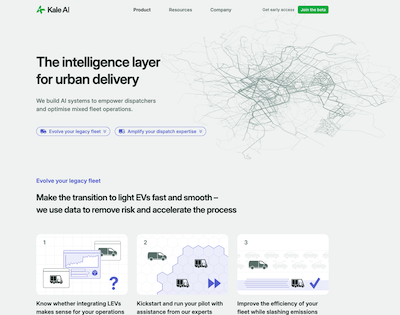
Kale AI is a company focused on solving the inefficiency problem in urban logistics. We build tools to make complex logistics planning easy. It’s a very hard and interesting problem, and planning is one of the biggest weaknesses of LLMs. We’ve been focused on supporting the transition to Light EVs and cargo-bikes in modern urban logistics fleets. Light EVs are up to 2x more efficient in dense urban areas and use 95% less energy than diesel vans. They’re a multi-solution to improve urban life.
3. Why do we need special routing for urban logistics?
Different vehicles need tailored routing because urban space is becoming increasingly complex. With improving cycling infrastructure, Low Traffic Neighbourhoods and so on, all of this can lead to improved efficiency if we better route vehicles through street networks. For example, a 2-wheeled cargo bike might be able to take a shortcut that a 3-wheeler is blocked from by a bollard. For the 2-wheeler that can save 5-10 minutes off their route, but having to backtrack could add this in additional time for the slightly larger vehicle.
Most of our work doesn’t focus specifically on “navigation” but on planning, assigning deliveries to vehicles and designing the sequence of stops on those routes. Dantzig, who first proposed the Vehicle Routing Problem, explains quite well why it’s hard in his 1958 paper: “Even for small values of n the total number of routes is exceedingly large, e.g. for n = 15, there are 653,837,184,000 different routes.”
In our research, we found that deliverers spend 60-80% of their day not driving, but looking for parking and walking to the door. Different vehicles have different performance advantages in different parts of a city. Light EVs have a big advantage in the centre. Our work focuses on leveraging the different strengths of each vehicle type, and taking into account that diversity makes the VRP even harder to solve.
4. What are the unique challenges involved in routing with OpenStreetMap, particularly for urban logistics?
The data quality is surprisingly good in well-mapped areas. The OSM community is incredibly detail-oriented. But two challenges stand out for us.
The first is completeness and heterogeneity. Coverage varies enormously, not just between cities but within them, and sometimes between streets that are literally 300 metres apart. In our research we found a striking example in Boston where two neighbouring hexagonal cells with almost identical satellite imagery had wildly different tagging. One had 167 highway:service tags, the other just 3. In Chicago suburbs we found a municipality with the highest population density in Illinois where OSM had recorded only 8% of its buildings. That kind of patchiness is a real problem when you’re trying to build models that generalise across cities.
The second is semantic consistency. OSM relies on contributors to categorise things freely, which means the same real-world object can be tagged in multiple ways depending on who mapped it and where. We saw this clearly across our study cities. Contributors in Los Angeles tagged single-family homes as building=house, while the same homes in other cities were tagged with the catch-all building=yes. Locally that’s fine, but the moment you try to build a model that works across cities, those inconsistencies become noise you have to work around.
And beyond the map itself, OSM captures the physical world but not the operational reality of deliveries. How long it takes to park, unload, walk to a door varies enormously by urban context and is invisible to any map. In our research, service time turned out to be one of the biggest drivers of delivery efficiency, yet almost no publicly available data exists on it. That’s a gap OSM can’t fill alone, but it points to how much logistics-specific ground truth is still missing.
5. What steps could the OpenStreetMap community take to improve mapping for urban logistics?
Keep tagging surfaces, seriously. It might feel niche, but it’s one of the most operationally significant pieces of data we use. The granularity OSM brings to surface data is something you simply can’t get from commercial providers, and it makes a real difference in planning accuracy.
Beyond that, access restrictions need more attention: bollards, width restrictions, turning restrictions, loading zone locations. These are the invisible barriers that can completely change how a fleet operates in a city, and they’re often missing or under-tagged. A restriction that a small vehicle sails through might stop a larger one entirely, and right now OSM rarely has enough detail to distinguish those cases.
More broadly, mapping Low Traffic Neighbourhoods and filtered permeability in a consistent, machine-readable way would be hugely valuable. These are increasingly shaping how urban freight actually moves, and having reliable structured data on them would let us plan far more accurately.
6. Recently OpenStreetMap celebrated 20 years. Where do you think the project will be in another 20 years?
I think OSM is going to become even more foundational than it already is, but probably in ways that are less visible. A lot of the most interesting work being done today in autonomous mobility, urban planning, and logistics quietly depends on OSM as a base layer. That’s only going to grow.
What excites me is the intersection with AI. Models are getting better at extracting structured data from imagery, which could dramatically accelerate how quickly OSM reflects the real world: new infrastructure, surface changes, new access restrictions. The community’s role might shift from purely manual contribution toward curation and validation at scale.
And as cities get more complex, with more vehicle types, more restricted zones, more differentiated infrastructure, the value of a community that actually cares about tagging a bollard correctly becomes hard to overstate. That local, granular knowledge is something no corporate mapping effort has ever quite replicated.
Thank you, Nico! Wonderful to see OpenStreetMap becoming a core part of the infrastructure of modern cities. As people, companies, communities use and rely on OSM, they will in turn start editing and maintaining the data for all of us to benefit.
Forward!
Please let us know if your community would like to be part of our interview series here on our blog. If you are or know of someone we should interview, please get in touch, we’re always looking to promote people doing interesting things with open geo data.